
Last updated September 25, 2026
Free written scope consultation - allowances, timeline, and change-order rules on paper before a single trade is scheduled







 Before
 After
After Before
 After
After Before
 After
AfterKitchen Remodeling Maintenance Checklist for Cupertino Homeowners
Silestone and Caesarstone both publish 10-year warranties on their quartz countertops - but both require annual sealer inspection documentation to honor a claim, a step that appears nowhere in most contractors’ handoff packets. In Cupertino, where a mid-range kitchen remodel runs between $75,000 and $140,000 and homeowners typically stay in place for eight to twelve years, that missing documentation step can turn a $2,400 countertop repair into a full replacement cost. This guide maps the maintenance schedule your materials actually require, the warranty documentation that protects your investment, and the Cupertino-specific conditions - hard water from the Santa Clara Valley Water District, seasonal temperature swings between the valley floor and the Foothill neighborhoods - that accelerate wear on systems most homeowners forget were installed.
Quick Answer
A kitchen remodel maintenance checklist for Cupertino homeowners should include monthly cleaning of quartz countertops with pH-neutral cleaner, quarterly inspection of undermount sink seals and cabinet hardware, semi-annual filter changes for range hood ventilation systems, and annual documentation of sealer condition on all stone surfaces. Maintenance logs should record dates, product names, and photos to satisfy manufacturer warranty requirements. Tasks involving gas lines, electrical circuits, or plumbing rough-ins require a licensed trade in California and should not be performed by homeowners.
Table of Contents

- Countertop Maintenance by Material
- Cabinetry and Hardware Care
- Undermount Sinks and Plumbing Systems
- Tile Backsplash and Grout Maintenance
- Ventilation and Electrical Systems
- Building Your Warranty Documentation Log
- Cupertino-Specific Wear Factors
- DIY Maintenance vs. Licensed Trade Work
 Before
 After
AfterCountertop Maintenance by Material
The countertops installed during your kitchen remodeling in Cupertino likely represent 15 to 25 percent of total project cost. Their maintenance requirements vary sharply by material, and manufacturer warranties contain specific conditions that void coverage if ignored.
Quartz (Engineered Stone): Silestone, Caesarstone, Cambria
Quartz countertops are marketed as “maintenance-free,” which is accurate only if you define maintenance narrowly. The resin binders in engineered stone - typically 7 to 10 percent of slab composition - can degrade with prolonged exposure to heat above 300°F or to alkaline cleaners above pH 10. Both Silestone and Caesarstone publish 10-year limited warranties covering manufacturing defects, but both require proof of “proper care” to process a claim.
What “proper care” means in practice:
- Daily: Wipe with warm water and mild dish soap. Dry with a microfiber cloth to prevent water spotting from Cupertino’s moderately hard water (grain hardness of 12 to 18 gpg from Santa Clara Valley Water District sources).
- Weekly: Clean with a pH-neutral stone cleaner such as StoneTech Revitalizer or MB-5. Avoid vinegar, lemon, bleach, and ammonia-based products - these etch the resin surface over time.
- Monthly: Inspect seams and edges for separation or chipping. Document with dated photos.
- Annually: Have a certified fabricator inspect the sealer condition at seams and around sink cutouts. Request a written report. Store this with your original invoice.
Heat damage is the most common warranty dispute we see. Trivets or heat pads are non-negotiable - a cast-iron skillet at 400°F will scorch quartz in under 90 seconds. The repair runs $400 to $800 for a partial resurfacing, and manufacturers consistently deny claims where thermal damage is evident.
Natural Stone: Granite, Marble, Soapstone
Granite and marble require more aggressive maintenance schedules. Sealer application frequency depends on porosity - a simple water-drop test tells you when reapplication is needed. Place a quarter-sized pool of water on the surface; if it absorbs in under 10 minutes, the stone needs sealer. In Cupertino kitchens with frequent cooking and exposure to acidic ingredients (tomato sauce, citrus, wine), we typically see absorption rates accelerate after 18 to 24 months.
Document each sealer application with product name, lot number, application date, and before/after photos. Warranty claims on stained natural stone are almost always denied without this record.
Solid Surface: Corian, Hi-Macs
Solid surface materials can be renewed with light sanding, but this resets the finish warranty if performed by anyone other than a certified fabricator. For routine maintenance, soapy water and a non-abrasive sponge suffice. Avoid exposing the material to strong solvents - acetone and paint thinner will craze the surface.
Cabinetry and Hardware Care
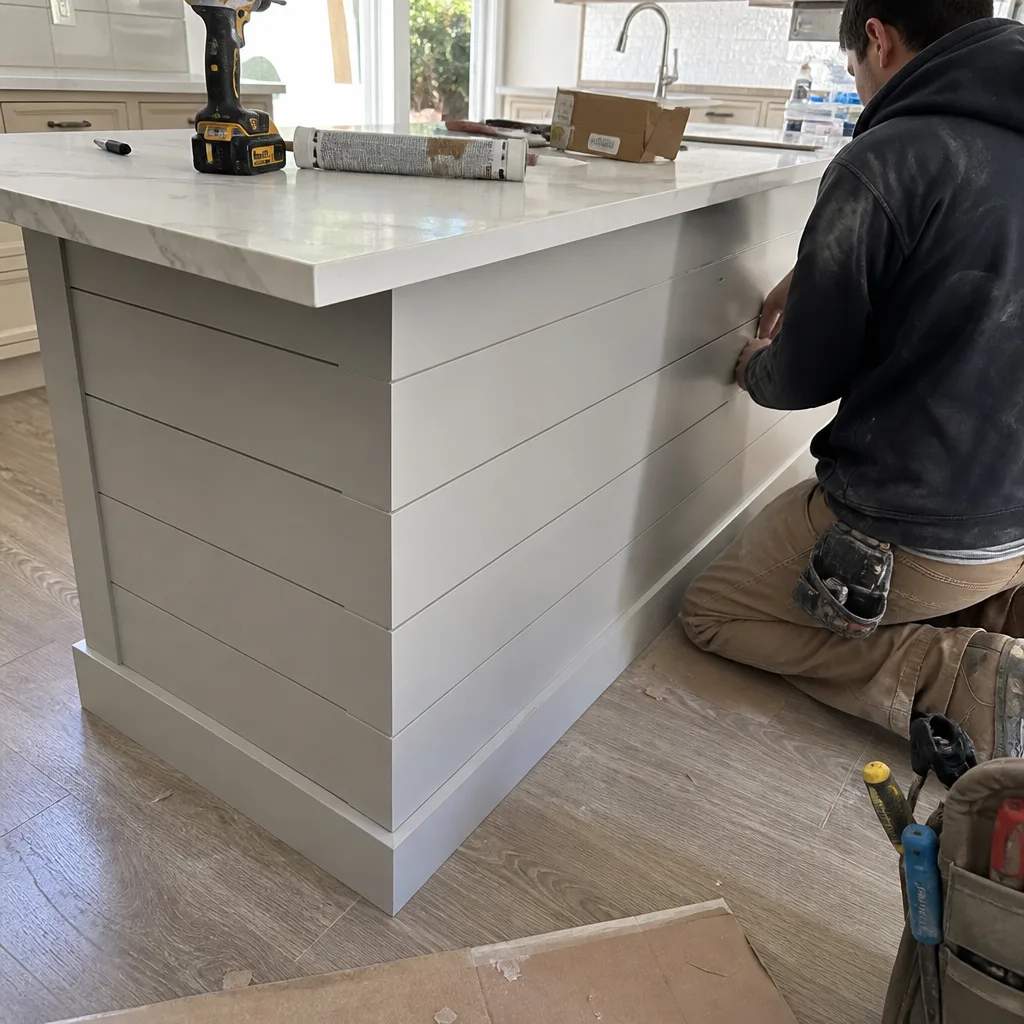
Shaker-style cabinetry remains the dominant choice in Cupertino kitchen remodels, and for good reason - the flat center panel and five-piece door construction tolerate humidity variation better than raised-panel alternatives. But “better” does not mean “without maintenance.”
Wood and MDF Cabinet Boxes
The substrate beneath your painted or stained finish determines how the cabinet responds to Cupertino’s seasonal humidity swings. Summer humidity in the Foothill neighborhoods can reach 65 to 70 percent; winter indoor humidity with heating running drops to 25 to 30 percent. That 40-point swing causes wood to expand and contract, stressing joints and finish coats.
Monthly tasks:
- Wipe cabinet faces with a damp (not wet) microfiber cloth, drying immediately
- Inspect door and drawer front alignment - misalignment indicates hinge or slide stress
- Check for finish cracking at joint lines, particularly on painted MDF
Quarterly tasks:
- Tighten hinge screws with a manual screwdriver, not a drill - over-torquing strips the pilot hole
- Lubricate drawer slides with a dry silicone spray (Blaster or similar)
- Inspect under-sink cabinet floor for moisture staining or warping
KraftMaid and Wellborn, two brands we quote regularly, both specify that hinge adjustment should be performed with the door weight supported - hanging a heavy door on a single hinge while adjusting the other stresses the mounting plate. This detail appears in installation manuals but rarely in homeowner handoff packets.
Hardware Finishes
Brushed nickel and matte black hardware dominate current Cupertino selections. Both finishes are plated over zinc or brass substrates. The plating thickness, measured in microns, determines longevity - quality hardware runs 15 to 25 microns; budget hardware runs 5 to 8 microns and shows wear in 18 to 24 months under normal use.
Clean hardware with a soft cloth and mild soap. Avoid abrasive cleaners and ammonia, which attack the lacquer topcoat. If plating begins to wear at contact points, replacement is the only remedy - replating hardware is rarely cost-effective.
Undermount Sinks and Plumbing Systems
The undermount sink installation method - where the sink basin attaches beneath the countertop rather than dropping in from above - creates a clean aesthetic but introduces a critical maintenance point: the silicone seal between sink rim and countertop underside. This seal bears the full weight of water and dishes, and it degrades predictably.
The Seal Inspection Schedule
Silicone sealant in a kitchen environment has a functional lifespan of 7 to 10 years, but Cupertino’s hard water accelerates degradation at the sink-to-counter interface. Mineral deposits accumulate at the seam, creating a crystalline wedge that stresses the bond.
- Monthly: Visually inspect the exposed seam from above. Look for gaps, discoloration, or lifting. Run a fingernail gently along the seam - soft or tacky silicone indicates breakdown.
- Quarterly: From below the sink, inspect the mounting clips or epoxy brackets that secure the sink to the countertop. Tighten clips if loose; epoxy failure requires professional reattachment.
- Annually: Apply a bead of 100% silicone sealant (GE Silicone II Kitchen & Bath or equivalent) along the interior seam as preventive maintenance. Wipe excess immediately with mineral spirits.
Sink detachment is a $1,200 to $2,800 repair involving countertop removal, sink replacement, and reseaming. The annual silicone application takes 15 minutes.
Faucet and Fixture Maintenance
Cupertino’s water supply, blended from local groundwater and imported surface water, carries 12 to 18 grains per gallon hardness and measurable silica content. Both deposit on aerators, cartridge valves, and spray heads.
Every 90 days, remove the faucet aerator and soak it in white vinegar for 30 minutes. Scrub with an old toothbrush. If flow remains restricted, replace the aerator - they’re $4 to $12 and thread standard. For pull-down spray heads, detach the hose connection and flush with vinegar solution.
Cartridge replacement is where homeowners often cross into licensed trade territory. Modern single-handle faucets use ceramic disc cartridges that seal with precision tolerances. A homeowner can replace a cartridge, but identifying the correct part requires the model number, and reassembly without damaging O-rings or alignment pins requires care. A failed cartridge replacement that leaks into the cabinet below causes exponentially more damage than the $180 to $350 a plumber charges for the service call.
Tile Backsplash and Grout Maintenance
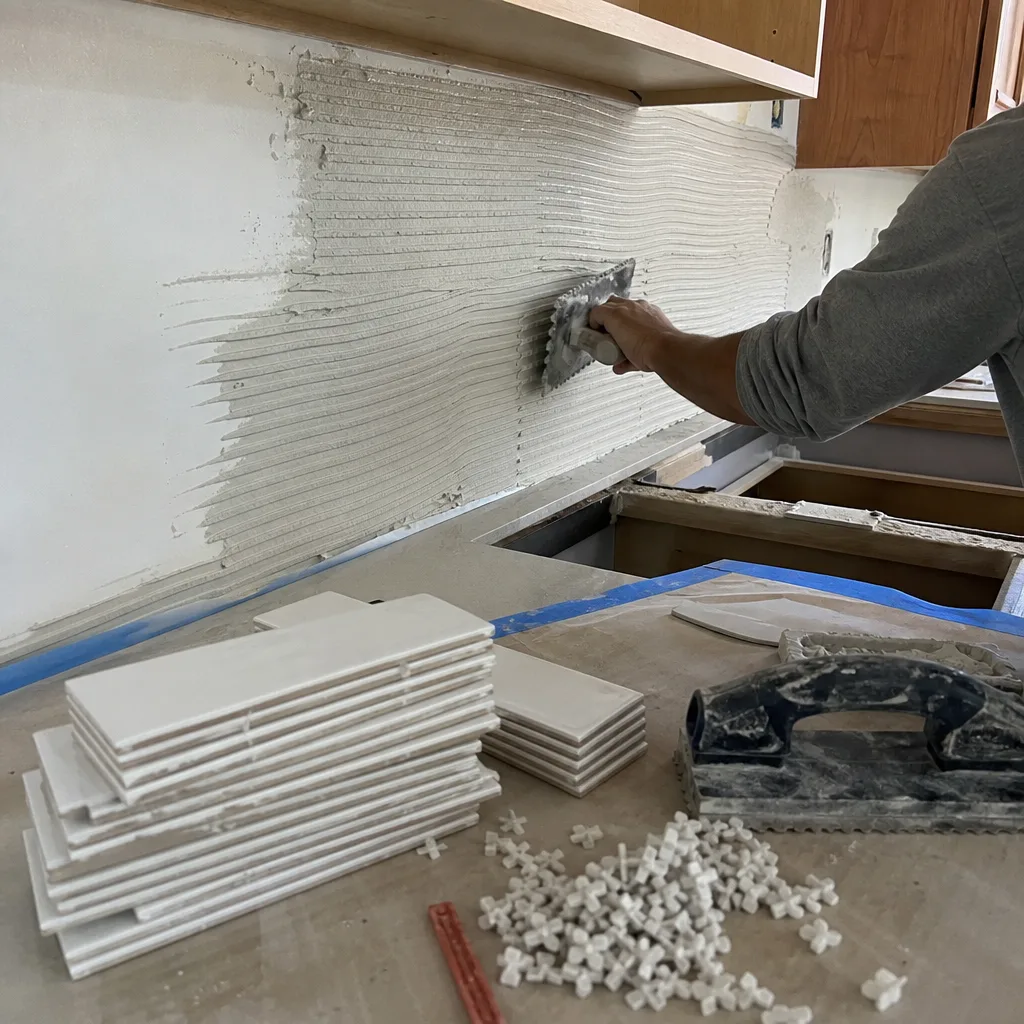
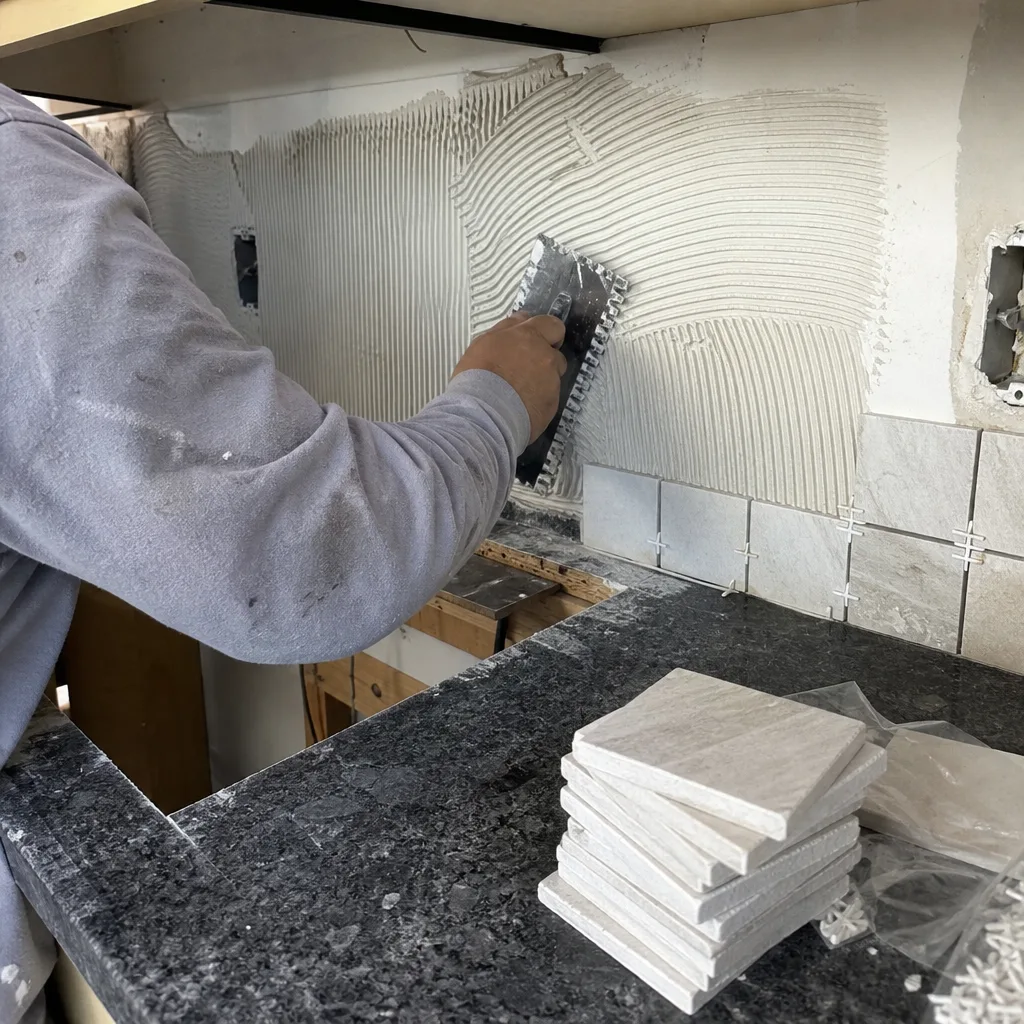
The backsplash occupies relatively little square footage but receives disproportionate exposure to grease, moisture, and cleaning chemicals. In Cupertino kitchens, where open-plan designs often place the backsplash in direct sightline from living areas, its condition significantly affects perceived kitchen quality.
Grout: The Hidden Maintenance Item
Grout is porous cementitious material - essentially concrete with sand filler. Unsealed grout absorbs cooking oils, wine, and cleaning solutions. Sealed grout resists absorption but requires resealing every 12 to 18 months in kitchen environments.
The maintenance sequence:
- Clean grout with a pH-neutral cleaner specifically formulated for grout (Aqua Mix or similar). Avoid bleach - it degrades grout integrity and lightens color unevenly.
- Allow 24 hours to dry completely.
- Apply penetrating sealer with a foam brush or small applicator bottle. Work in 2-square-foot sections, wiping excess from tile faces within 10 minutes.
- Buff tile with dry microfiber after 30 minutes.
- Document product, date, and coverage area in your maintenance log.
Epoxy grout, increasingly specified for Cupertino remodels, is non-porous and does not require sealing. However, epoxy yellows with UV exposure and can stain from oil-based cooking residues. Clean with pH-neutral products only - acidic cleaners etch the epoxy surface.
Tile-Specific Considerations
Subway tile, the prevailing backsplash choice, has rectified edges that permit tight grout joints (1/16 to 1/8 inch). These narrow joints are harder to clean and reseal than wider joints. Hand-painted or artisan tile, seen increasingly in Monta Vista and Rancho Rinconada renovations, may have surface irregularities that trap residue - clean with a soft brush, never abrasive pads.
Glass tile and metal accent strips require different cleaners than ceramic or porcelain. Ammonia-based products streak glass; abrasive cleaners scratch metal. Check manufacturer specifications - they’re specific and warranty claims are denied for improper cleaning agent use.
Ventilation and Electrical Systems
The range hood installed during your remodel is not an appliance - it’s a ventilation system with ductwork, electrical circuitry, and in many Cupertino installations, makeup air requirements under California Title 24 energy code. Its maintenance affects indoor air quality, fire safety, and code compliance.
Range Hood Filter Maintenance
Baffle filters (stainless steel, dishwasher-safe) and mesh filters (aluminum, replaceable) require different schedules:
- Baffle filters: Clean monthly in dishwasher or with degreaser. Inspect for corrosion annually - salt air from the Bay, while mild in Cupertino, accelerates stainless pitting over time.
- Mesh filters: Replace every 6 to 12 months. Cleaning extends life marginally but compressed mesh reduces airflow efficiency.
Charcoal filters in recirculating hoods (non-ducted installations, common in condo conversions) require replacement every 6 months. They’re not cleanable - the adsorption media saturates and stops working.
Ductwork Inspection
Every 24 months, inspect the duct run from hood to termination. In Cupertino’s older neighborhoods - Rancho Rinconada, portions of Monta Vista - ductwork may pass through unconditioned attic space where temperature swings create condensation. Check for:
- Grease accumulation at joints and low points (fire hazard)
- Damper flap operation at exterior termination
- Insulation integrity on ducts in unconditioned space
Duct cleaning by a specialized service runs $300 to $500 and is warranted if grease buildup is visible. This is not a homeowner task - the duct interior is inaccessible without tools, and disturbance of accumulated grease creates fire risk.
Electrical Circuit Verification
California Electrical Code requires dedicated 20-amp circuits for kitchen countertop receptacles and separate dedicated circuits for dishwasher, disposal, and range hood. The remodel permit and inspection verify initial compliance, but GFCI and AFCI protection devices have finite lifespans.
Test GFCI receptacles monthly using the test/reset buttons. If a button is stuck, loose, or fails to trip, replace the device - they’re $15 to $25, and replacement is within capable homeowner scope if the panel is de-energized at the breaker. AFCI breakers in the panel require electrician testing every 3 to 5 years; thermal damage from loose connections is not visually detectable.
Under-cabinet lighting, increasingly LED tape or puck systems, generates less heat than halogen predecessors but still requires inspection of driver/transformer units. These fail thermally - look for discoloration, buzzing, or flickering. LED drivers are matched to specific tape configurations; replacement requires matching voltage and wattage precisely.
Building Your Warranty Documentation Log

For more guides & resources on protecting your investment, see our blog. Manufacturer warranties are insurance products with claims departments trained to deny coverage for procedural failures. Your maintenance log is the documentation that converts a likely denial into an approved claim.
What to Record
For each material or system, maintain a single file (physical or digital - cloud storage with date-stamped uploads is preferable) containing:
- Original purchase invoice with date, product name, color/serial number, and installing contractor
- Manufacturer warranty document, with registration confirmation if required
- Maintenance activity log with dates, products used, and photos
- Professional inspection reports with contractor license number and signature
The photo record is critical. Warranty claims for countertop damage require “before condition” documentation to prove the damage is not wear-related. A photo log showing consistent good condition supports your position.
Storage and Access
Store digital records in at least two locations - cloud service and local backup. Physical records in a fireproof document box. The 10-year quartz warranty is worthless if the documentation burns in a house fire.
When a claim arises, the manufacturer will request:
- Proof of purchase date
- Proof of professional installation (not DIY)
- Maintenance records showing compliance with care instructions
- Photos of damage with scale reference
- Written estimate for repair or replacement
Our crews at Rowan Construction Group Cupertino home provide a project closeout packet with warranty registrations initiated, product data sheets, and a maintenance schedule template. Most contractors do not - if yours didn’t, request the information or reconstruct it from invoices and manufacturer websites.
Cupertino-Specific Wear Factors
Maintenance schedules developed for other climates or water conditions require adjustment for local conditions, as detailed in our Seasonal Construction Care for Cupertino: Year-Round Homeowner’s Guide. Cupertino presents specific factors that accelerate certain failure modes.
Hard Water Effects
The Santa Clara Valley Water District supplies water with 12 to 18 grains per gallon hardness, varying seasonally with the blend of local groundwater (harder) and imported State Water Project supplies (softer). This water leaves mineral deposits on:
- Faucet aerators and spray heads (flow restriction, valve wear)
- Glass shower doors in adjacent bathrooms (etching if not squeegeed)
- Grout and natural stone (surface buildup, reduced sealer effectiveness)
- Stainless steel sinks (water spotting, potential pitting)
A whole-house or point-of-use water softener reduces but does not eliminate these effects. If your remodel included a water softener, maintain the brine tank and resin bed per manufacturer schedule - typically salt replenishment every 6 to 8 weeks and resin replacement every 10 to 15 years.
Temperature and Humidity Variation
Cupertino’s microclimate varies sharply with elevation. Foothill neighborhoods (Monta Vista, portions of Rancho Rinconada) experience wider daily temperature swings and higher summer humidity than valley-floor properties near Stevens Creek. Homes in these areas see more pronounced wood movement in cabinetry and more condensation on ductwork in unconditioned attics.
Winter heating in these same homes often runs drier, increasing static electricity and wood shrinkage. A whole-home humidifier, if installed, requires pad replacement and drain line cleaning annually - a task frequently omitted from homeowner maintenance awareness.
Seismic Considerations
California’s seismic requirements affect cabinet installation - code-compliant cabinets mount with seismic restraints to wall studs, not merely screwed through drywall. After any significant seismic event (MMI IV or above, which Cupertino experienced during the 2014 South Napa earthquake), inspect cabinet mounting for looseness, particularly upper cabinets where failure is hazardous.
DIY Maintenance vs. Licensed Trade Work
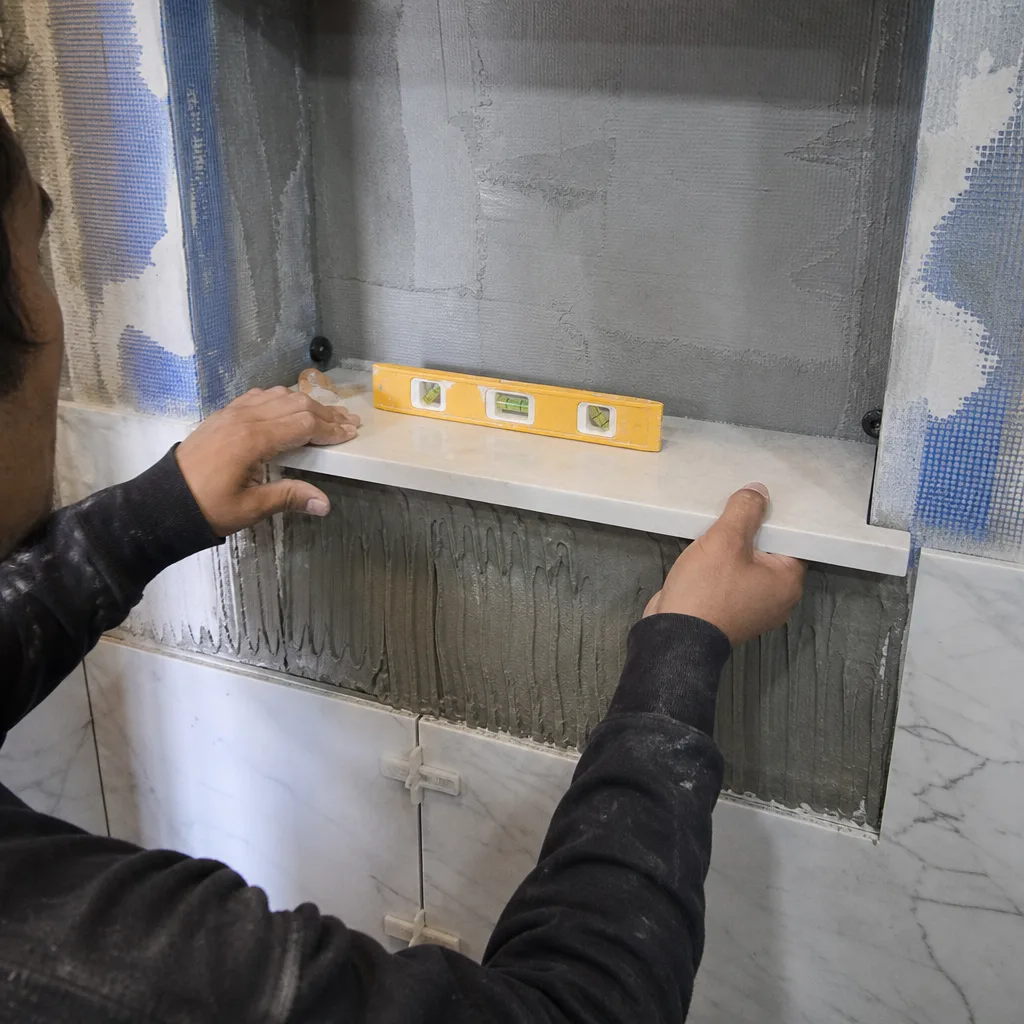
The boundary between homeowner maintenance and licensed trade work is not intuitive, and crossing it carries dollar consequences that escalate quickly.
Homeowner-Appropriate Tasks
| Task | Frequency | Typical Cost if DIY | Typical Cost if Pro |
|---|---|---|---|
| Countertop cleaning and inspection | Daily/weekly | $15-30 in supplies | N/A |
| Grout sealing | Annual | $25-50 in materials | $300-500 |
| Faucet aerator cleaning | Quarterly | $5 in vinegar | $120-180 service call |
| Range hood filter cleaning | Monthly | Detergent | N/A |
| GFCI testing | Monthly | Free | $120-180 service call |
| Cabinet hardware tightening | Quarterly | Free | $120-180 service call |
Licensed Trade Required
California law and practical safety require licensed professionals for:
- Gas line work: Any modification, leak testing, or appliance connection. The California Plumbing Code requires a C-36 license. A homeowner-performed gas repair that causes damage voids insurance coverage. Typical service call: $180-350; leak repair: $400-800.
- Electrical panel and circuit work: AFCI breaker replacement, circuit additions, panel upgrades. C-10 license required. Arc flash hazard from panel interiors causes serious injury annually. Service call: $180-350; circuit work: $500-1,500.
- Plumbing rough-in modifications: Moving drain lines, vent stack modifications, pressure testing. C-36 license. A failed DIY drain repair that floods cabinetry causes $5,000-15,000 in damage. Reputable contractors carry insurance that covers this risk; homeowner work does not.
- Structural modifications: Cabinet removal affecting wall framing, load-bearing considerations. B license or structural engineer involvement. Permits required; unpermitted work disclosed in sale can reduce value or void sale.
The cost differential between DIY and pro for simple tasks is meaningful - $25 versus $300 for grout sealing. But the cost of a failed DIY attempt on licensed-trade work is typically 10 to 50 times the professional fee. We document this in every project closeout conversation: the Haven Standard’s Clause 1 written price applies to our work, but it also applies to the work you don’t attempt yourself.
Common Mistakes to Avoid
- Using vinegar on quartz or natural stone. The acidity etches resin binders in quartz and calcite in marble. We see this damage in Cupertino’s newer developments where homeowners apply “natural cleaning” principles indiscriminately. The repair is not warranty-covered.
- Ignoring undermount sink clip corrosion. Galvanized steel clips in Cupertino’s humid summer conditions rust through in 5 to 7 years. Stainless clips last longer but cost $8 more per set at installation - a detail some contractors omit. Check your clip material; replace galvanized proactively.
- Skipping range hood duct cleaning. Grease accumulation is a latent fire hazard. The National Fire Protection Association reports cooking equipment as leading cause of home fires. Duct cleaning every 24 months is cheap insurance at $300 to $500.
- Failing to register warranties within 30 days. Silestone, Caesarstone, and many cabinet manufacturers require registration for full warranty terms. The reminder email gets buried; set a calendar alert for project completion plus 14 days.
- Confusing “water-resistant” cabinet boxes with waterproof. MDF and particleboard substrates swell irreversibly when saturated. A leaking sink trap left unaddressed for a weekend destroys a $400 cabinet box. The annual under-sink inspection catches this early.
- Over-tightening hardware screws. Power drills strip pilot holes in MDF and particleboard, creating loose mounts that wallow out. Manual screwdriver, firm pressure, stop when seated - this is the technique we demonstrate at project closeout.
- Neglecting seasonal GFCI testing. GFCI devices fail silently - the test button is the only verification. A failed GFCI in a kitchen circuit creates shock hazard near water sources. The 30-second monthly test is non-negotiable.
When to Call a Professional

Call a licensed professional when you observe: water staining or softening in cabinet bases; persistent odors from range hood or sink drain; visible sparking, discoloration, or warmth at electrical outlets; cabinet or countertop separation from walls; or any gas odor near cooktop or oven connections. These symptoms indicate conditions beyond homeowner maintenance scope and carry safety or structural implications.
For kitchen systems installed during a remodel, Rowan Construction Group Cupertino offers free estimates to assess condition and recommend maintenance or repair - call (669) 202-9618. Our crews carry documented photo records on every visit, and our 365-Day Done Right Promise applies to any service we perform.
Frequently Asked Questions
Annual countertop maintenance for a typical Cupertino kitchen runs $75 to $200 in materials - pH-neutral cleaners, sealer, microfiber cloths - plus $300 to $500 if you hire professional grout or stone sealing. Quartz requires less sealer investment than natural stone but still needs annual inspection documentation for warranty purposes. Call (669) 202-9618 for an exact quote on professional maintenance services - estimates are free.
No - manufacturer warranties cover defects in materials and manufacturing, not damage from impact, heat, or improper cleaning. Silestone and Caesarstone specifically exclude “abuse, misuse, or failure to follow care instructions.” Your maintenance log proves you followed instructions, which is necessary but not sufficient for claim approval. The damage must also be traceable to a material defect, not user action.
Reseal cementitious grout every 12 to 18 months in kitchen environments, or when the water-drop test shows absorption in under 10 minutes. Cupertino’s hard water accelerates sealer degradation at the grout surface, so err toward 12 months for backsplashes behind cooktops where grease and cleaning exposure are highest. Epoxy grout does not require sealing.
Faucet replacement on existing connections does not require permit in Cupertino. Garbage disposal replacement on existing wiring and plumbing typically does not require permit, but new installation or relocation does. Any work involving gas lines, new electrical circuits, or drain line modification requires permit and licensed trade. When in doubt, call the City of Cupertino Building Division at (669) 202-9618 - or call us at (669) 202-9618 and we’ll verify permit requirements for your specific scope.
The Haven Standard is a documented system with specific clauses, not a marketing promise. Clause 1 requires a written price before any work starts. The 365-Day Done Right Promise states that if work is not done right, Rowan makes it right - backed by a terms page, not an asterisk. Typical contractor warranties are verbal or one-page documents with undefined “workmanship” terms and no specified remedy process. We provide the Haven Standard terms page at proposal; customers can review it before signing.
Proper undermount support uses metal clips anchored to the cabinet frame or a support rail, plus silicone adhesive at the rim-to-countertop joint. From below, you should see clips every 8 to 12 inches around the perimeter, none missing or loose. The sink should not flex or move when you press upward on the basin bottom. If you see epoxy-only attachment, missing clips, or movement, call for inspection - sink detachment causes cascading damage to cabinet and countertop.
The Bottom Line

Kitchen remodel maintenance is not housekeeping - it’s warranty preservation and investment protection. The materials installed in your Cupertino kitchen carry manufacturer coverage measured in years, but that coverage requires documented compliance with specific care requirements. Quartz countertops need annual sealer inspection records. Grout needs resealing on a schedule tied to your actual water conditions. Ventilation systems need filter maintenance that affects both air quality and fire safety. The homeowners who protect their investment are those who treat the maintenance schedule as seriously as the remodel itself - with written records, dated photos, and clear boundaries between DIY scope and licensed trade work. The cost of this discipline is modest; the cost of neglect is replacement at full price, with no warranty recourse.
Written by Grant Rowan, Owner at Rowan Construction Group Cupertino, serving Cupertino since 2007.